

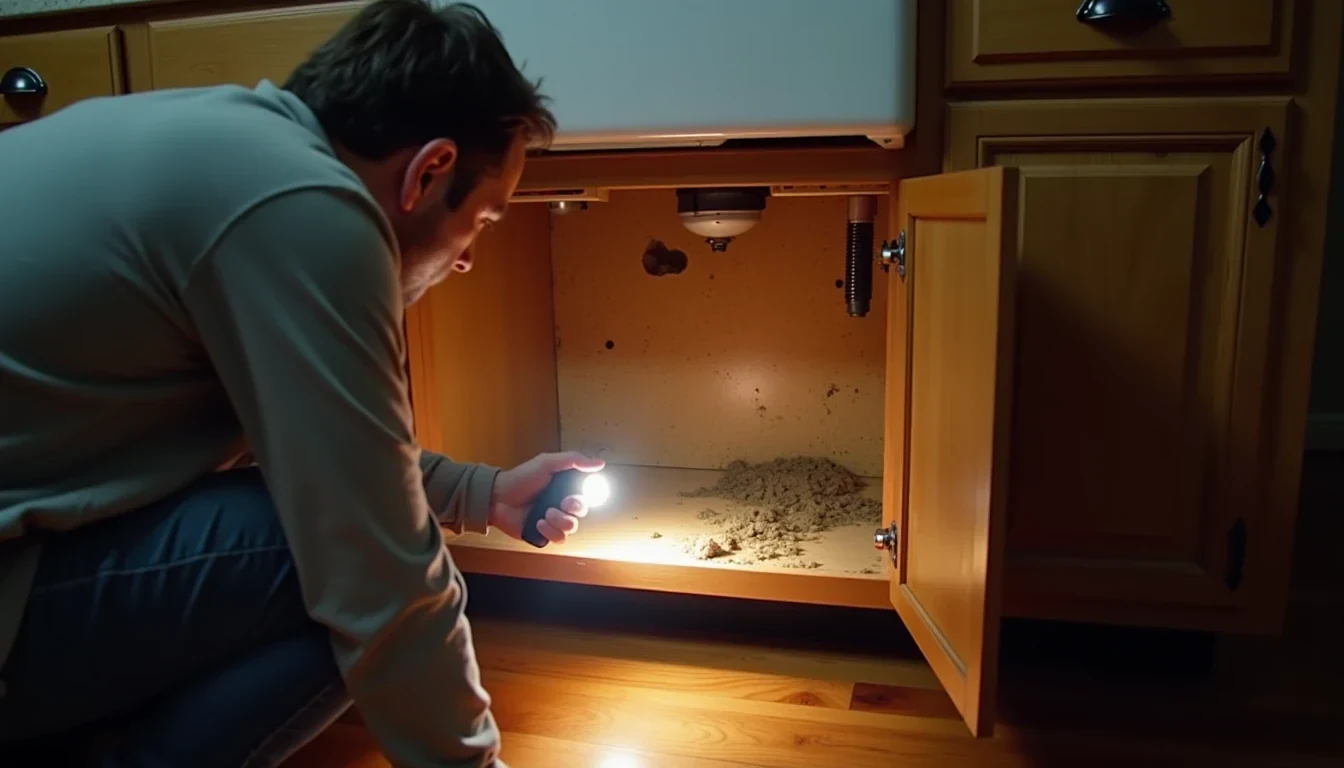
The first thing a homeowner notices is the door peeling or the handle loose. By then, the real damage has already spread through the parts they never inspect. Inside a sink cabinet, behind the kick plate, along the raw ellipse where the plumber punched through for the waste pipe, moisture has been creeping into exposed chipboard or MDF edges for months. The carcass swells, softens, and loses its grip on screws. The premium shaker door, still pristine, now hangs crooked on a frame that has turned to pulp. This failure mode dominates South African kitchens and bathrooms and is almost entirely preventable.
Where the Water Actually Gets In
Plumbing cut-outs are the most aggressively unprotected edges in any cabinet. A sink base unit carries three critical vulnerabilities: the waste outlet hole, the tap mounting slots, and the base panel sitting directly beneath the P-trap. Dishwasher openings present a different threat. Steam vents from the bottom of the door during drying cycles, and that hot, wet air meets the vertical edges of the adjacent cabinet carcass precisely where standard edge banding ends. Bathroom vanities compound the problem with ambient humidity in poorly ventilated spaces; water does not need to leak to cause damage. It merely needs to persist in the air.
Research on board behavior is unambiguous. Standard particleboard manufactured to basic SABS 1211 specifications can absorb enough moisture through an unsealed edge to swell by fifteen percent or more within weeks of first exposure. MDF, denser and more uniform, resists slightly longer but fails just as definitively once water breaches the surface. The visible laminate or melamine face might look untouched while the core beneath it balloons, splits, and crumbles.
Board Grade Is the Foundation
Not all engineered boards respond equally. V313-grade particleboard, also designated MR for moisture resistant, incorporates melamine-urea-formaldehyde resins that reduce water absorption by roughly half compared to standard grades. For high-exposure applications, this should be the minimum specification. PG Bison supplies V313 particleboard explicitly for carcass construction, and any kitchen manufacturer worth quoting should confirm this grade on the order. The price premium over standard board runs approximately ten to fifteen percent on material, which translates to perhaps R200-R400 on a typical sink base unit. This is the entire cost of the insurance policy.
Marine plywood offers a step up in structural integrity. True marine-grade ply uses WBP phenolic adhesive between cross-laminated veneers, and species like Okoume or Birch perform better than the Saligna or Meranti alternatives more commonly stocked locally. Supply chain availability and cost are the catch. A marine plywood carcass can run two to three times the price of V313 particleboard, which pushes it toward yacht kitchens and high-end commercial wet areas rather than standard residential specification.
Compact laminate, built from kraft paper layers saturated with phenolic resin and compressed under heat, is effectively waterproof throughout its thickness. It machines cleanly, carries no separate surface layer to delaminate, and ignores humidity entirely. The downside is weight and price. At roughly R1,800-R2,500 per square metre for material depending on thickness and supplier, compact laminate belongs at the vanity top or the sink base panel specifically, not necessarily across every cabinet in the kitchen.
Edge Sealing Separates Professional Specification from Shortcut Work
The cut edge is the emergency exit moisture takes when the faces are protected. Edge banding with standard EVA hot-melt adhesive, applied in a hurry on an old machine running too fast, leaves micro-gaps at the glue line. Water tracks along these gaps, under the banding, and into the core. PU hot-melt adhesive, polyurethane-based, forms a bond that is both stronger and substantially more moisture-resistant. The material cost difference is minimal, roughly R5-R15 per linear metre of edge banding. This creates a cabinet that survives a leaking dishwasher hose versus one that does not.
For plumbing cut-outs specifically, edge banding alone is insufficient. The curved or irregular edge left by a hole saw or jigsaw cannot be banded cleanly. Here, the specification should call for direct sealing of the raw edge with marine-grade silicone or a two-part epoxy paint applied before the plumber connects fittings. This step is rarely included in standard kitchen quotes because it adds labor time and material cost, perhaps R50-R100 per cabinet. It is also the single most effective measure against the failure mode described in this article.
Thicker PVC or ABS edge banding, at 1mm or 2mm rather than the standard 0.4mm, provides additional physical protection against impact and moisture. The application quality matters as much as the material. Proper pressure, temperature, and feed speed on a quality edge banding machine produce a seamless bond. Hand-applied iron-on banding, or pre-glued strips pressed on with a domestic iron, should not be accepted for wet-area cabinets.
Joint Construction and the Details That Fail Last
Carcass assembly methods determine whether a cabinet holds together once moisture does penetrate. D3 or D4 rated PVA wood glues, such as Titebond III, maintain bond integrity even with intermittent humidity exposure. Standard PVA, the yellow carpenters’ glue used for dry-area furniture, re-emulsifies and weakens when wet. Dowel and biscuit joints, common in mass-produced cabinetry, rely on glue surface area. Dado or rebate joints, more common in custom or higher-specification manufacture, offer mechanical resistance to joint opening even if adhesive performance degrades.
Kick plates at floor level should run on continuous aluminium or PVC profiles, not raw board edges sitting directly on screed or tiles. Cleaning water, minor flooding, or condensation from cold water pipes on a concrete floor wicks upward into unprotected chipboard within hours. The profile costs perhaps R80-R150 per linear metre and eliminates this pathway entirely.
The Real Cost of Getting It Wrong
A swollen sink base carcass, still carrying its original doors and hardware, represents a peculiarly frustrating waste. The visible components remain serviceable while the structure beneath them has failed. Replacement requires disconnecting plumbing, removing the countertop, extracting the damaged unit, and installing a new carcass with all joints, fittings, and adjustments. Material for a replacement base unit runs R2,500-R6,000 depending on size and specification. Labor for removal and reinstallation typically matches or exceeds material cost. A plumber’s call-out for disconnection and reconnection adds R800-R2,500. If water has damaged flooring, adjacent cabinets, or wall finishes, repair costs escalate rapidly.
The alternative, specifying properly from the outset, adds perhaps R400-R800 to the initial cost of a wet-area cabinet. The payback period is measured in months, not years, if any plumbing connection ever weeps, steams, or overflows.
What to Specify on the Order
For builders, contractors, and homeowners preparing to quote or place a kitchen order, the following checklist addresses the specific failure mode this article describes. No single item is sufficient; the protection is layered.
Board specification: V313 moisture-resistant particleboard or MR-grade MDF minimum for all sink, dishwasher-adjacent, and vanity carcasses. Confirm grade in writing on the order. Upgrade to marine plywood or compact laminate for the sink base panel specifically if budget permits.
Edge banding adhesive: PU hot-melt specified, not EVA. Confirm application on all edges, including internal shelves and divider panels, not just visible front edges.
Plumbing cut-out sealing: Raw edges at waste holes, tap penetrations, and pipe entries sealed with marine-grade silicone or two-part epoxy before installation. This should be a line item, not assumed.
Joint adhesive: D3 or D4 PVA or equivalent specified for all carcass assembly. Reject standard PVA for wet-area cabinets.
Kick plate protection: Continuous aluminium or PVC base profile specified, with end caps to prevent water ingress at profile terminations.
Door mounting: Confirm hinge specification and screw length appropriate for the board thickness specified. Hinges pulling out are often the first visible symptom of a swollen carcass losing screw retention.
The premium door, perfectly finished in PG Bison MelaWood SupaMatt or a high-gloss acrylic from Niemann SA, deserves a carcass that will support it for the duration of its aesthetic life. Suppliers like Easylife Kitchens and Kitchen Studio can deliver this specification when asked. Asking for it separates a kitchen that lasts from one that becomes an expensive renovation project before the handles have tarnished.
Join the conversation