

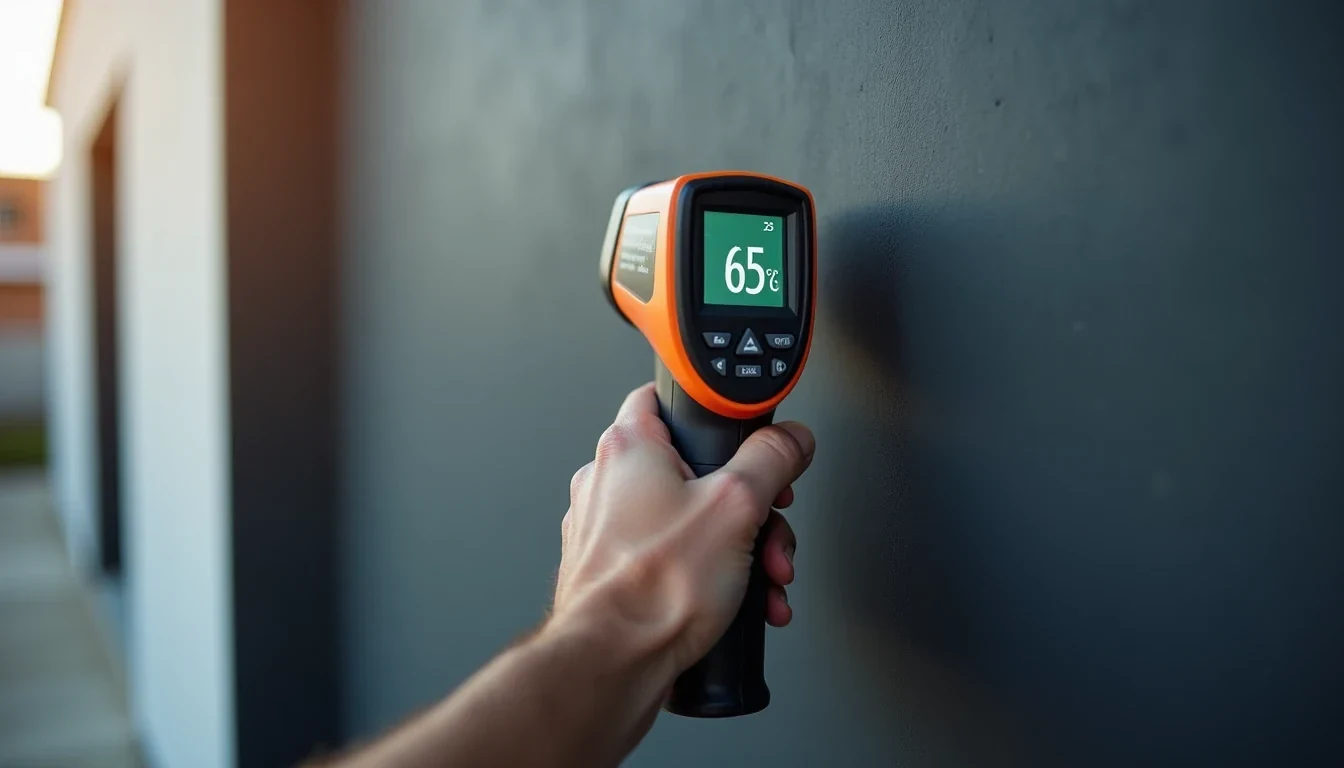
A north-facing wall painted in Plascon Micatex Deep Slate will hit 65°C by 14:00 on a Highveld January afternoon. The identical wall in Plascon Micatex White, three metres away, stops at 38°C. That 27-degree gap is a specification error that will crack your plaster, void your warranty, and run your air conditioner until your prepaid meter begs for mercy.
The “unpaid radiator” effect occurs when a dark finish converts solar radiation into surface heat faster than the substrate can dissipate it. In South African conditions, where peak irradiance regularly punches past 1000 W/m², colour choice becomes a durability decision first and an aesthetic one second.
What the thermometer actually shows
Surface temperature testing on exposed walls in Johannesburg and Pretoria consistently produces the same spread. A near-black finish with a Light Reflectance Value below 10 will stabilise between 60°C and 75°C in direct midday sun. A mid-tone grey at LRV 30-40 lands in the 50-55°C range. Standard off-whites above LRV 80 hold at 35-45°C. The delta accelerates as LRV drops because darker surfaces absorb across the full solar spectrum, not just visible light.
Material matters as much as pigment. Lightweight fibre cement cladding, such as Nutec or Marley Building Systems boards, spikes fastest. Thin metalwork, pre-painted IBR from Safintra or Colorplus sheeting from Macsteel, follows within minutes. Timber, even dense hardwood, absorbs that heat into its grain structure and begins moisture cycling almost immediately. Only high thermal mass assemblies, thick plaster on double brick, show any meaningful lag, and even they succumb to accumulated stress over seasons.
A dark west-facing wall in Cape Town, catching that low, penetrating afternoon sun, can remain above 50°C until 18:00 in midsummer. The heat does not vanish when the shadow hits; it has already migrated into the substrate and is now migrating inward.
Where the material starts to fail
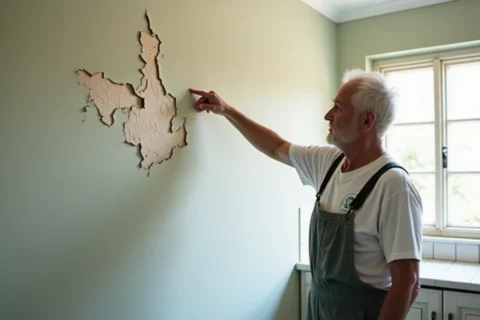
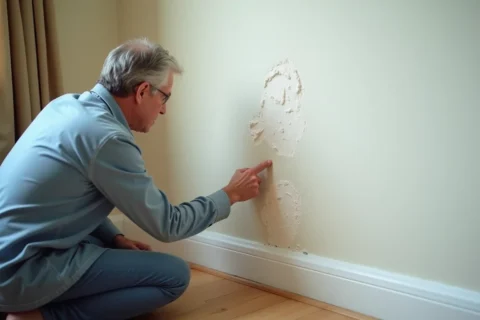
Plaster is the first casualty. Cementitious render expands and contracts with temperature swings. A dark finish on a north or west face can cycle through 30°C of variation in a single day, hundreds of times per year. Hairline cracking appears at stress concentrations, window corners, door frames, the junction where brick meets concrete lintel. Once the crack network is established, winter rain enters, summer heat drives it back out as vapour pressure, and the delamination sequence begins. SABS 1514 plaster and SABS 1586 paint standards assume reasonable thermal exposure, not a facade operating at 70°C.
Timber moves differently. Dark stains or solid colour coatings on pine, meranti, or balau drive rapid surface drying while the core remains relatively damp. The resulting stress produces checking, cupping, and end-splitting. The protective film, whether varnish or acrylic, degrades faster at elevated temperature. The coating meant to protect the timber becomes the thermal accelerator that destroys it. Re-coating intervals on dark exterior timber in KZN or Limpopo can halve compared to lighter alternatives.
Metal cladding presents its own failure mode. Pre-painted steel expands significantly across its length when dark finishes push surface temperature into the mid-60s. The phenomenon called oil-canning, that visible waviness between fasteners, is often thermal expansion exceeding the panel’s restraint capacity. Fasteners loosen, washers compress permanently, and the seal fails. The coil coating itself, whether standard polyester or premium PVDF, chalks and fades faster when baked repeatedly. Safintra and Macsteel warranties for colour retention and chalk resistance explicitly reduce coverage for low-LRV colours, or void them entirely on certain profiles.
The warranty wall you cannot see
Plascon and Dulux both publish LRV thresholds in their technical data sheets, though finding them requires deliberate searching. Plascon Micatex, specified for exterior plaster and fibre cement, carries reduced warranty terms for colours below LRV 20 on lightweight substrates. Dulux Weatherguard operates similarly, with additional restrictions for direct-to-timber applications in dark bases. Warranties are conditional on the specifier’s colour choice being appropriate for the substrate and orientation.
Nutec and Marley Building Systems go further. Their fibre cement board warranties explicitly reference dark colour limitations for certain fixing patterns and expansion gap configurations. Install a dark finish with standard 4mm gaps on a north face, and the thermal expansion can close those gaps entirely, inducing edge-cracking that the manufacturer will correctly classify as specification error.
Metal cladding warranties are the most colour-sensitive of all. A Colorplus or Chromadek sheet in a dark base colour, installed on a low-pitch roof or vertical west face, may carry half the warranty duration for chalk and fade resistance compared to the same product in a light colour. The documentation is unambiguous once located. Most claims denials stem from specifiers who never looked.
Orientation as design discipline
Not every wall suffers equally. South-facing surfaces in the Southern Hemisphere receive minimal direct beam radiation year-round. A dark finish here is thermally defensible, even strategically sound for visual weight or heritage matching. East faces catch morning sun that is intense but brief; the substrate has hours to dissipate before the next cycle. North and west faces are the danger zones, with north accumulating the most total daily energy and west delivering the most punishing late-afternoon load.
This creates a usable rule: dark colours belong on south faces first, east faces with caution, north faces only with material and cooling strategy deliberately engineered for the load, and west faces almost never. A single dark west wall can undo the thermal performance of an otherwise well-designed envelope, pushing interior temperatures past the threshold where ceiling fans or cross-ventilation can recover comfort. The air conditioner starts, and the R2.50 to R3.00 per kWh Eskom or municipal tariff begins its daily accumulation.
Internal temperature rises of 3°C to 5°C attributable to dark exterior surfaces are routinely measured in South African residential monitoring. That translates to two to four additional hours of compressor operation daily through summer, or alternatively, an oversized HVAC unit selected to handle a load that lighter colours would have eliminated.
What to specify instead
“Cool colour” technology, offered by Plascon and Dulux in selected ranges, uses infrared-reflective pigment chemistry to reduce solar absorption without lightening the visible colour dramatically. The effect is real but bounded. A cool dark grey might run 8°C to 12°C cooler than a standard dark grey, but it still operates well above a light base. It is mitigation, not magic.
For metal cladding, specify light colours on all high-exposure faces regardless of aesthetic preference. If the design demands visual darkness, use shadow gaps, recessed panels, or secondary screening elements that do not form the primary weathering surface. For timber, accept that dark means maintenance, and specify inspection and re-coating cycles in the maintenance manual, not as an afterthought.
On plaster, the safe specification is LRV 40 or above for north and west faces, with LRV 60 or above as the conservative default. If a client insists on darker, document the orientation restriction, the expected thermal performance, and the warranty limitation. The signature on that document will focus the conversation in ways that verbal warning does not.
What to check before you order
1. Obtain the LRV for the exact colour from the manufacturer’s colour fandeck or technical service, not by eye. 2. Cross-reference that LRV against the substrate-specific warranty conditions in the current TDS. 3. Map the wall orientation against the solar exposure it will receive in midsummer. 4. Confirm the cooling strategy, passive or mechanical, can handle the calculated additional load. 5. For timber and metal, verify expansion detail and fastener specification against the thermal range the dark colour will produce. 6. Record the client’s colour choice and orientation in writing, with noted warranty limitations, before application begins.
The almost-black wall at sunset is a genuine pleasure. The same wall at 14:00, radiating stored heat into your living room while your plaster develops a crack network that will cost R15,000 to repair in three years, is a specification failure. Colour is not decoration on a facade. It is a thermal decision with mechanical consequences. Treat it as such from the first sample pot.


Join the conversation