

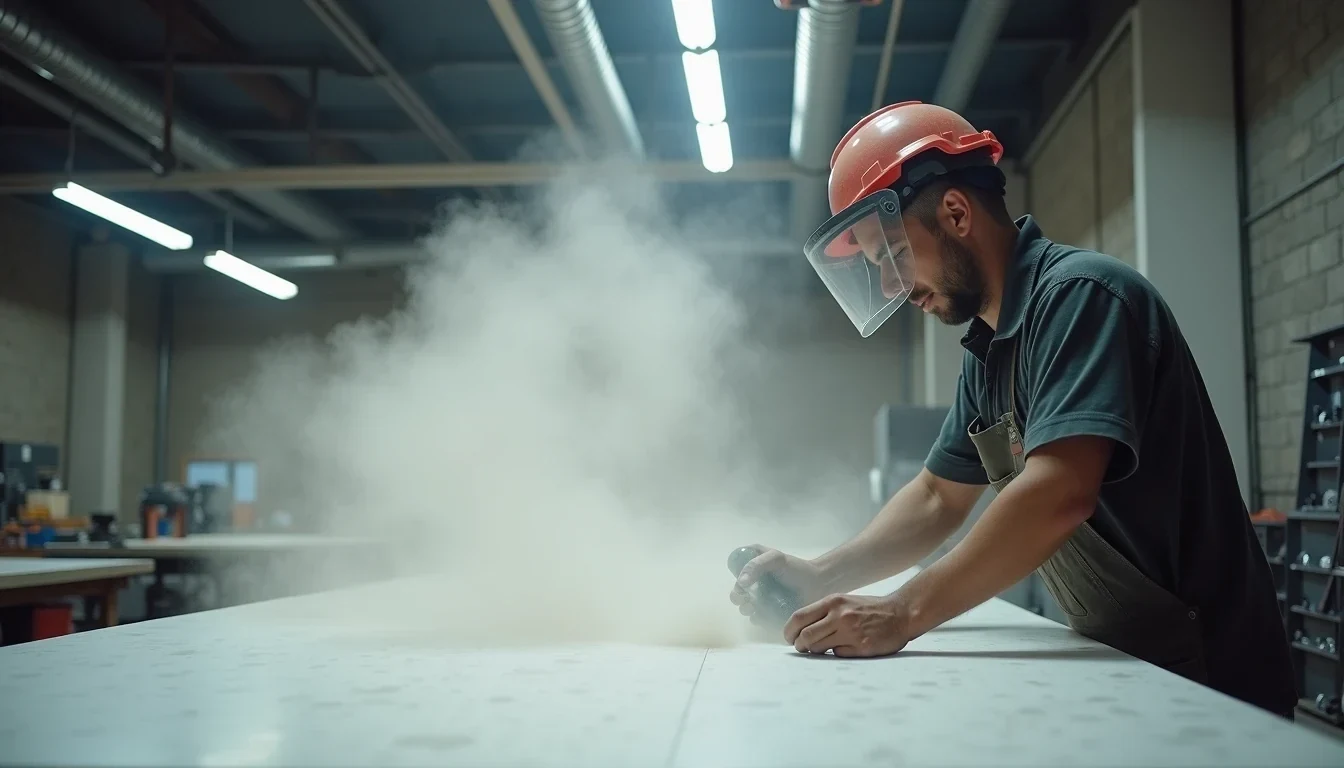
The polished Caesarstone slab that arrives on your kitchen island never made anyone sick. The worker who cut it to size might never breathe properly again. This is the central fact of engineered stone fabrication that every homeowner, builder, and designer in this market needs to grasp before they sign off on a countertop order.
Engineered quartz surfaces carry silica concentrations of 90 to 95 percent by weight, bound in resin. In the finished kitchen, that silica stays locked away. In the fabrication workshop, diamond blades and abrasive pads fracture that same silica into respirable particles smaller than five micrometres, invisible and inescapable. The resulting dust penetrates deep into lung tissue, where it triggers inflammation, fibrosis, and progressive, irreversible scarring. This is silicosis. It arrives in three forms, each faster and more brutal than the last. Chronic silicosis builds over decades of moderate exposure. Accelerated silicosis compresses that timeline to five or ten years. Acute silicosis can kill within months of intense exposure. The International Agency for Research on Cancer classifies crystalline silica as a Group 1 human carcinogen. In South Africa, where tuberculosis already strains the public health system, silica-damaged lungs become fertile ground for active TB infection.
Why Engineered Stone Hits Harder Than Natural
Granite carries silica too, typically 25 to 45 percent. That is substantial, but it pales against the engineered product. The manufacturing process that produces uniform colour and predictable performance also concentrates the hazard. When a fabricator cuts a granite slab, the dust contains silica. When that same fabricator cuts a Caesarstone 5100 Vanilla Noir or a Stone Africa engineered surface, the airborne concentration of respirable crystalline silica can reach levels hundreds or thousands of times above any safe threshold. The energy input is identical, but the material response is not.
South African regulation recognises this distinction in practice if not in separate classification. The Hazardous Chemical Substances Regulations of 1995, promulgated under the Occupational Health and Safety Act, impose a strict framework on employers handling silica-containing products. The Occupational Exposure Limit for respirable crystalline silica sits at 0.1 milligrams per cubic metre, averaged across an eight-hour shift. Some international guidelines push for 0.05 mg/m³, and workshops serious about worker protection treat the lower figure as their operational ceiling. Compliance demands air monitoring by accredited occupational hygienists, medical surveillance including lung function tests and chest X-rays, documented risk assessments, and a hierarchy of controls that puts engineering solutions ahead of masks and paperwork.
What the Regulations Actually Require
The HCS Regulations mandate specific, verifiable actions. Employers must identify every hazardous chemical substance on site, assess the risk of exposure, implement controls to prevent or reduce that exposure, monitor airborne concentrations against the OEL, provide medical surveillance for exposed workers, and train those workers to understand what they are facing. SANS 10228, the national standard on classification and labelling, feeds into this framework by ensuring that silica-containing materials are properly identified and handled from delivery onwards.
Enforcement carries teeth. Non-compliance can trigger fines, stop-work orders, and criminal charges against company directors. Enforcement capacity is finite, and the countertop fabrication sector includes numerous small workshops operating at the margins of formal oversight. This is where the buyer enters the picture.
The Questions That Separate Responsible Fabricators from Cowboy Operations
A homeowner selecting a Caesarstone 4600 Organic White at R4,800 per square metre installed, or a builder specifying engineered stone across a multi-unit development, holds more leverage than they realise. The person writing the cheque can demand transparency about workshop conditions. The fabricator who has invested in proper dust control will answer willingly. The one who has not will deflect, obfuscate, or bluster.
Start with the cutting process itself. Wet cutting is the single most effective engineering control. Water applied at the point of blade contact suppresses dust at source, binding particles into slurry rather than releasing them into breathable air. Dry cutting with extraction is better than nothing. Dry cutting with no extraction and no water is a death sentence for workers, delivered slowly or quickly depending on exposure intensity. Ask specifically: do you wet-cut every slab, every edge, every cut-out? If the answer hedges, press harder.
Ventilation systems matter next. Local exhaust ventilation with HEPA filtration captures what water suppression misses. Ask whether the workshop maintains LEV units, who inspects them, and how often. Request maintenance records. A fabricator with nothing to hide will produce them.
Personal protective equipment sits at the bottom of the hierarchy for good reason. It is the last line, not the first. But where engineering controls cannot eliminate exposure entirely, workers need properly fitted P3 or N100-equivalent respirators, individually fit-tested to ensure seal integrity. Ask what respirators workers wear, who conducts the fit testing, and how frequently. A dust mask from Builders Warehouse does not qualify.
Cleaning protocols reveal operational discipline. Wet mopping and HEPA-filtered industrial vacuuming remove settled dust safely. Dry sweeping re-aerosolises it. Compressed air hoses turn settled hazard into airborne hazard all over again. Ask how the workshop floor gets cleaned at shift end. The wrong answer is a definitive red flag.
Medical surveillance is a legal requirement, not a courtesy. Workers exposed to silica must receive regular lung function testing and chest X-rays to catch early damage before symptoms appear. Ask whether the fabricator maintains this programme and whether workers have been examined within the required intervals.
The Installed Surface Is Not the Problem
This bears repeating because confusion serves no one. A Caesarstone countertop in a Bryanston kitchen or a KZN coastal renovation does not release silica dust during normal use. The resin matrix encapsulates the silica particles. Standard cleaning with household products does not fracture that matrix. Minor chipping does not create meaningful exposure. Even drilling a new tap hole generates trivial quantities compared to workshop fabrication, though wet drilling and vacuum capture remain sensible precautions.
The risk lives in the transformation, not the product. Homeowners need not fear their countertops. They need to fear the conditions under which those countertops were born, and they need to wield their purchasing power to demand better.
What to Specify on the Order
For builders and designers, this translates into contract language. Before placing a deposit, insert a clause requiring the fabricator to confirm in writing that all engineered stone cutting, grinding, and polishing occurs with water suppression and LEV systems operational, that air monitoring records demonstrate compliance with the 0.1 mg/m³ OEL, that workers wear fit-tested P3 respirators where exposure persists, that cleaning follows wet methods or HEPA vacuuming exclusively, and that medical surveillance is current for all exposed employees. Attach a copy of the HCS Regulations if necessary. The fabricator who balks at this paperwork is announcing their non-compliance in advance.
For homeowners, the checklist is simpler but no less important. Ask the questions directly. Visit the workshop if possible. A wet floor and visible water on cutting equipment are positive signs. A haze of fine dust in the air, workers in basic paper masks, dry floors, and the whine of unventilated dry-cutting equipment are signals to walk away and find another supplier. Stone Africa, Caesarstone SA authorised fabricators, and established operators with national footprints have more to lose from a silicosis prosecution than a one-man band in an industrial park. This does not guarantee compliance, but it shifts the probability.
The Price of Silence
Silicosis is irreversible. There is no cure, only progression management. Workers who develop accelerated or acute silicosis from engineered stone exposure are typically young men in their twenties and thirties, often with dependent families. The social cost lands on the public health system and the workers’ households. The private cost lands on fabricators who face compensation claims, regulatory action, and criminal liability. The moral cost lands on everyone who knew the risk and chose not to ask.
South Africa’s regulatory framework is already in place. It lacks consistent enforcement and consistent buyer pressure. Every countertop order is an opportunity to apply that pressure. The polished surface in your kitchen is safe. The question is whether you paid for it with someone else’s breath.
Join the conversation