

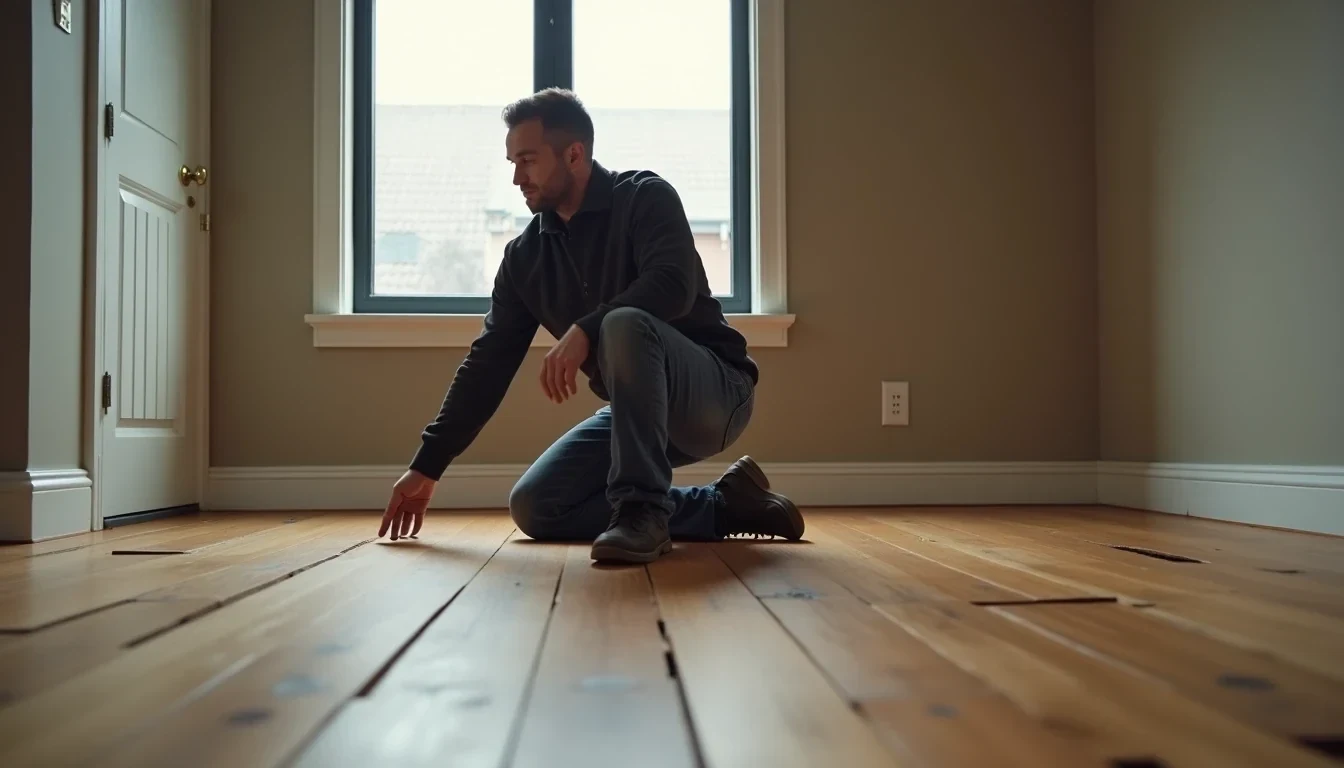
A foreman on a Parkhurst renovation last year told his client the screed had been down for three weeks and was “dry enough” for the engineered oak. By month four, the boards had cupped so aggressively you could catch a sock on the edges. The adhesive had turned to paste beneath the surface. The R180,000 floor came up entirely, and the screed had to be ground back and started again. Three weeks was never a moisture result; it was a calendar entry, and it cost someone a year of their budget.
Why Surface Dryness Deceives
Cement screeds and concrete slabs hold construction moisture like a sponge holds water in its centre while the outside feels firm to the touch. The surface can look pale, sound hollow when tapped, and pass the careless boot-test, but the body of the screed still carries litres of water per cubic metre working slowly upward. This is not a flaw in the material. Hydraulic cement cures and dries by releasing moisture through evaporation over weeks or months depending on thickness, ambient humidity, and whether the mix was poured with a water-reducing admixture or the old-fashioned wet-slump approach.
A 50mm screed laid in a well-ventilated Highveld winter might reach acceptable moisture levels in 50 to 70 days under good conditions. A 100mm slab in a humid Durban basement could need four months. The 1mm-per-day rule of thumb applies only to the first 40mm, after which drying slows dramatically. Contractors who quote “three weeks” are not measuring; they are hoping.
What Actually Fails When Flooring Goes Down Too Soon
The damage does not announce itself immediately. Moisture migrates upward through the screed, hits the impermeable flooring layer, and has nowhere to go. For timber, this causes dimensional chaos. Boards absorb water from below, swelling against each other, cupping at the edges, crowning at the centres, or buckling entirely off the subfloor. Engineered oak is not immune. The cross-layered construction resists some movement, but sustained moisture exposure separates the wear layer from the core, and the adhesive fails.
Vinyl and LVT suffer differently but no less terminally. Moisture re-emulsifies pressure-sensitive and acrylic adhesives, causing tenting, bubbling, and delamination. Plasticiser migration turns clear wear layers yellow and brittle. The floor looks aged within months. Resinous coatings blister from osmotic pressure, or cure soft and tacky, losing chemical resistance and wearing through in patches.
Beneath all of these, mould colonises the interface. The smell arrives before the visible staining. Occupants with respiratory sensitivity notice first. By then, the flooring is already condemned.
The Tests That Actually Measure Readiness
South African practice recognises two quantitative methods for screed moisture assessment, both referenced in SANS 10070 for flooring installation preparation.
The Calcium Carbide method takes a ground sample of screed, mixes it with calcium carbide reagent in a sealed vessel, and measures the acetylene gas pressure generated. This pressure correlates directly to percentage moisture content by mass. It is destructive, precise, and widely accepted. Site testing runs R350 to R600 per point, excluding travel, with multiple points across the slab for any floor of consequence.
The in-situ Relative Humidity probe method drills holes to 40 percent of slab thickness for drying concrete, or 20mm for screed overlays, inserts calibrated probes, and seals them for equilibrium over 24 to 72 hours. Protimeter and Tramex equipment are common on local commercial sites. Probes cost R800 to R1,500 each, with three to five probes typical per 100 square metres, plus reading fees. The RH method predicts future moisture vapour emission more reliably than surface readings, and most timber and vinyl manufacturers specify it.
Electrical resistance meters have their place for preliminary surveys, identifying wet zones that need proper testing. They do not provide quantitative data adequate for final approval. The plastic sheet test, sealing a square metre of polyethylene for 48 hours and checking for condensation underneath, is a crude indicator only. It confirms moisture exists, but it does not confirm absence.
What the Manufacturers Actually Require
Product warranties are explicit. They are voided by installation over damp screeds, with no exceptions or goodwill gestures.
Solid and engineered timber flooring generally demands maximum 2.5 percent CM by calcium carbide test, or 75 percent RH by in-situ probe. Premium products or specified adhesive systems may require 65 percent RH. Vinyl flooring, whether LVT or sheet, typically matches the 2.5 percent CM or 75 percent RH threshold, with some high-performance lines demanding 70 percent or lower. Resinous coatings vary by system. Plascon’s epoxy ranges generally specify 75 percent RH maximum, or 4 percent moisture content by gravimetric method, with certain moisture-tolerant primers allowing up to 80 percent RH where explicitly specified.
These numbers appear in Technical Data Sheets that contractors rarely download and almost never attach to their quotations. The liability sits with the installer when the floor fails, and the manufacturer will produce the TDS in any dispute.
The Real Cost of Rushing
The pressure is real. Painters want access. Kitchens are scheduled. The client has a move-in date advertised to family. Flooring contractors get squeezed between trades and promises, and the temptation to accept “dry enough” is constant.
The arithmetic does not favour the shortcut. A failed 100 square metre LVT installation at R300 to R800 per square metre installed represents R30,000 to R80,000 in direct material and labour write-off. Remediation, including removal, disposal, possible screed grinding or replacement, moisture barrier application, and reinstallation, typically runs two to three times the original cost. On commercial projects, liquidated damages for programme delay add thousands of Rands per day. The R2,000 to R4,000 that proper CM or RH testing would have cost becomes negligible.
Reputational damage is harder to quantify but longer lasting. A contractor with two moisture-related floor failures in a neighbourhood develops a name that outlives any advertising budget.
What to Specify and Verify
For homeowners, builders, and designers specifying moisture-sensitive flooring over new screed or slab, the checklist is short and non-negotiable.
Confirm screed thickness and document the pour date. Calculate minimum drying time at 1mm per day for the first 40mm, then add contingency for thickness beyond that, for humid conditions, and for any curing compounds or membranes that slow surface evaporation. Specify the test method in the flooring contract, not as an optional extra. For timber and vinyl, require in-situ RH probes or calcium carbide testing with results below manufacturer limits, documented and attached to the installation warranty. For coatings, obtain the specific TDS for the specified product and verify the applicator has tested to those limits, not generic assumptions.
Do not accept “three weeks” as an answer. Three weeks is how long the screed has existed. It is not a measurement that determines whether your floor will survive.
Join the conversation