

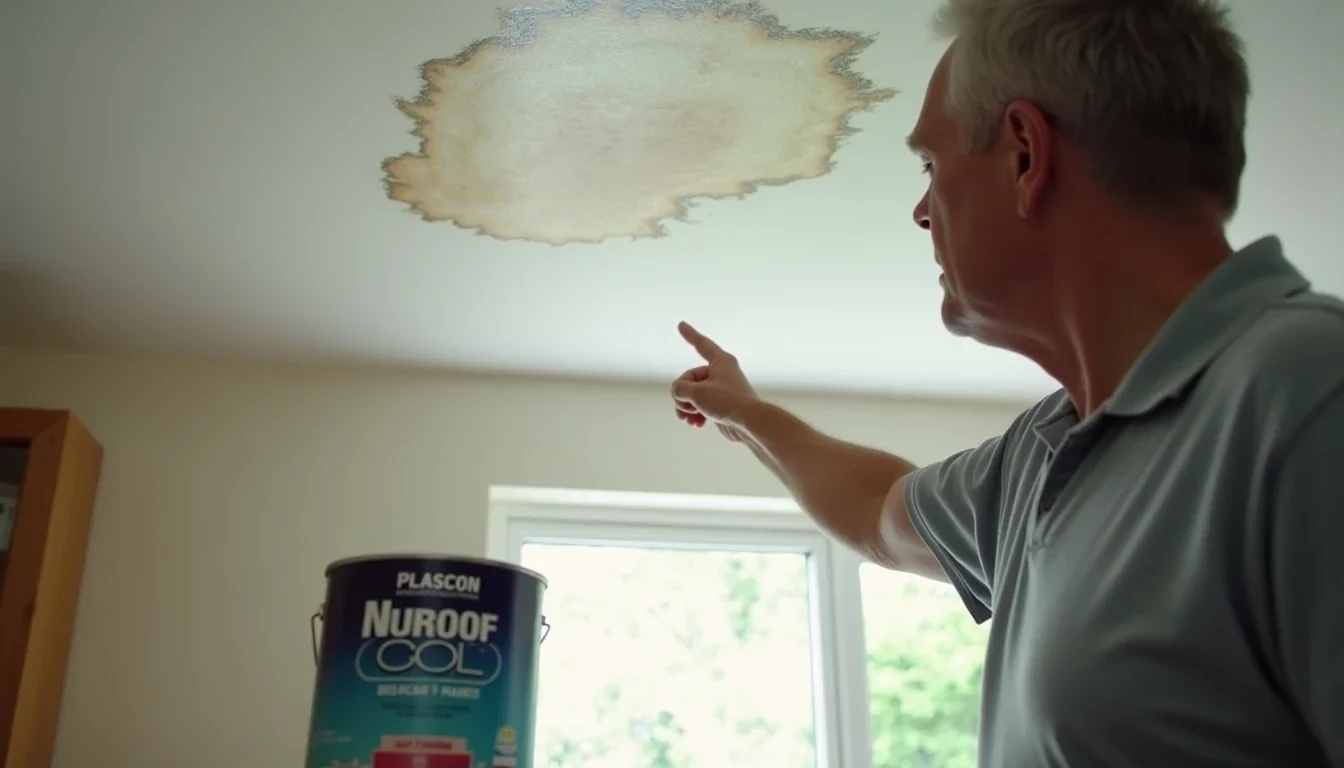
A Plascon Nuroof Cool tin on a hardware shelf in Randburg promises waterproofing in bold lettering. Someone buys it, rolls it across a flat concrete roof in Linden, and believes the job is finished. Six months later, the ceiling below the parapet is blistering. Another coat goes down, then another. By the third application, the owner has spent R14,000 on paint and still wakes up to a brown stain spreading above the kitchen light. The coating never failed at what it was designed to do; it was never designed to do what the owner believed.
Why the Tin Lies
Roof coatings are surface treatments. They protect against UV degradation, reflect heat, and bridge hairline cracks up to about 0.5mm. They are not engineered membranes. A complete waterproofing system, the kind SANS 10400-L mandates for flat or low-pitch roofs, is a multi-layered assembly: primer, reinforced membrane, proper upstands, and detailing components at every junction. The standard’s deemed-to-satisfy provisions explicitly require this system to be installed by competent personnel per manufacturer specifications.
Millions of rands in water damage accumulate in the gap between those two categories, coating and system. A coating sits on top. A system integrates with the structure, extending 150mm minimum up parapet walls, forming sealed collars around pipes, and creating watertight transitions at outlets that can handle hydrostatic pressure and structural movement. When a homeowner reads “waterproof” on a Dulux Weatherguard Roof tin, they reasonably assume the product satisfies building regulations. It does not, not on its own, and not on a flat concrete slab where ponding is possible.
Where Water Actually Enters
The broad center of a flat roof is rarely the problem. Water finds the interruptions. Parapet junctions fail first because the concrete slab and the vertical wall expand and contract at different rates. The membrane, if it exists, must accommodate that movement while maintaining adhesion to both surfaces. A coating cannot. It cracks at the base of the parapet, right where the wall meets the roof, and water tracks behind the paint film.
Outlets and drains concentrate the failure. A blocked outlet on a Joburg flat roof after a Highveld thunderstorm creates a pool. Hydrostatic pressure builds against the thin coating, pushing through any imperfection. Without a properly flanged drain detail where the membrane bonds mechanically to the outlet body, water enters the slab edge and migrates laterally. The owner sees the ceiling damage three meters from the actual leak source and coats the wrong area.
Flashings around chimneys and skylights, penetrations for vent pipes and HVAC lines, movement joints between structural bays: each represents a geometric complexity that demands specific detailing. A coating gets rolled over these transitions. The coating film is uniform, but the underlying structure is not. The mismatch guarantees separation.
The Path of a Leak
Consider a concrete flat roof in Greenside, last waterproofed fifteen years ago with a torch-on membrane that has since cracked at the parapet base. The owner, responding to interior damp, hires a painter who applies Plascon Nuroof Cool at R85 per litre, approximately R45 per square metre for two coats. The fresh white surface looks correct. The parapet crack, now hidden, continues to admit water during summer storms.
The outlet, partially blocked with leaf litter and builder’s debris, ponds water against the coating for days after rain. The coating, rated for minor crack bridging, faces continuous immersion. It softens. The ponding area grows as the outlet blockage worsens. Water finds a second path through a poorly sealed vent pipe penetration, saturating the insulation layer above the ceiling board.
Inside, the damage appears as a spreading stain on the gypsum ceiling. The owner calls another painter. A second coat goes down, this time Dulux Weatherguard Roof at R92 per litre. The stain continues. A third application, now totaling R12,600 in product and labour, masks the outlet blockage completely. The ponding deepens. The concrete slab undergoes freeze-thaw cycling in winter, microcracking accelerates, and rebar corrosion begins. The repair that should have cost R18,000 for proper outlet clearing, parapet detail reconstruction, and localised membrane replacement now requires R67,000 for slab remediation, ceiling replacement, and electrical work.
The Cost of Misdiagnosis
Repeated coating applications fail structurally and economically. Each layer adds weight and traps moisture against the substrate. Incompatible products between coats cause delamination. The original failure points, buried under fresh paint, become harder to locate. Diagnostic work that should take two hours of methodical water testing extends to days of destructive investigation.
The competent person requirement in SANS 10400-L exists because waterproofing demands forensic attention to transitions. A registered waterproofing contractor would have identified the parapet crack with a simple visual inspection. They would have cleared the outlet and verified drain flow rates. They would have cut back the failed membrane, prepared the concrete, and installed new torch-on or liquid-applied reinforced membrane with proper upstand termination and penetration collars. The system would carry a ten-year performance warranty. The coating carries none.
What to Specify Instead
For a flat concrete roof in South Africa’s climate zones, specify as follows. The substrate requires cleaning, repair of spalls and cracks wider than 0.5mm, and priming compatible with the membrane system. The membrane itself, torch-on modified bitumen at 3mm or 4mm thickness or a liquid-applied reinforced system from a manufacturer such as Derbigum or a Sika-certified applicator, must extend 150mm minimum up all parapets and walls. Outlets require proprietary flanged drain inserts with membrane welded or bonded to the flange, not sealant alone. Penetrations need flexible collars integrated with the main membrane. Movement joints demand specific bridge details with reinforced flexible sections.
The coating, if used at all, is a sacrificial UV protection layer applied over a complete system, or a temporary aesthetic refresh on a roof already verified as structurally sound and properly waterproofed. It is not the waterproofing. The tin does not say this clearly enough; the building code does.
Checklist for Specification
- Verify roof slope achieves 1:80 minimum to outlets; if not, specify tapered insulation or screed falls before membrane installation
- Confirm existing substrate condition; do not apply any product over saturated concrete or active leaks without remediation
- Require membrane installation by a manufacturer-certified applicator with SANS 10400-L competence documentation
- Specify outlet flow testing and debris guards as part of the works
- Demand 150mm minimum upstands at all parapets and walls, with mechanical termination where wind uplift is a risk
- Include ten-year system warranty from membrane manufacturer, not contractor-only guarantee
- Reserve coating products for UV protection over completed systems, never as primary water resistance
The ceiling stain does not care what the tin promised. Water follows structure, not marketing.



Join the conversation