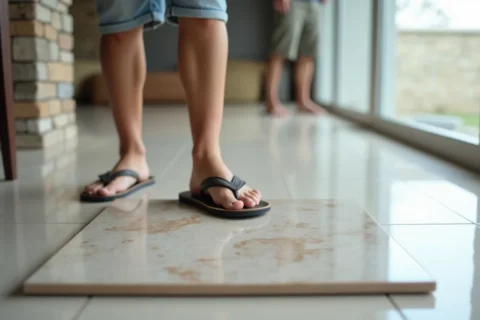

A floor can look like oak and still behave like a soaked cardboard box with good PR. That is the trap. The display board sells a picture, but the bathroom leak, the dishwasher drip, and the wet mop after Sunday lunch all judge the core, the seam, and the glue, not the photograph on top.
Cut the sample open and the hierarchy is obvious. Laminate is a printed skin over fibreboard. Engineered wood is real timber on a stabilised base. Luxury vinyl is a synthetic stack built to shrug off water. Once you see the layers, the argument changes fast.
What you are actually buying
Laminate flooring is usually an HDF or MDF core with a decorative print and a hard melamine wear layer. The oak is only an image. When moisture gets into the board, the fibres drink it, and the plank moves in an undesirable way.
Engineered wood is closer to a wood sandwich. The top face is genuine timber, often oak, bonded to a multi-ply or HDF base for stability. It still contains real wood, so it moves with moisture. However, it offers the option to sand and refinish the face if the wear layer is thick enough, which laminate never can.
Luxury vinyl, whether glue-down LVT or rigid SPC, is synthetic through the body. The look is printed, the wear layer is clear, and the core does not swell the way fibreboard does. Vinyl survives kitchen accidents better than the other two, even if the marketing language around it gets sloppy.
The dishwasher test is brutal for a reason
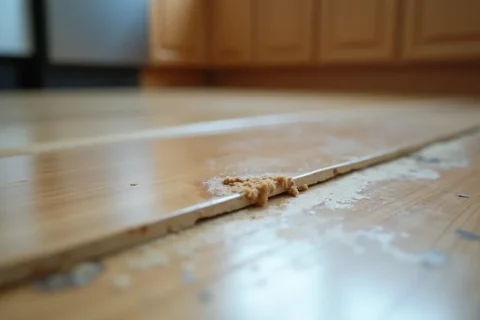
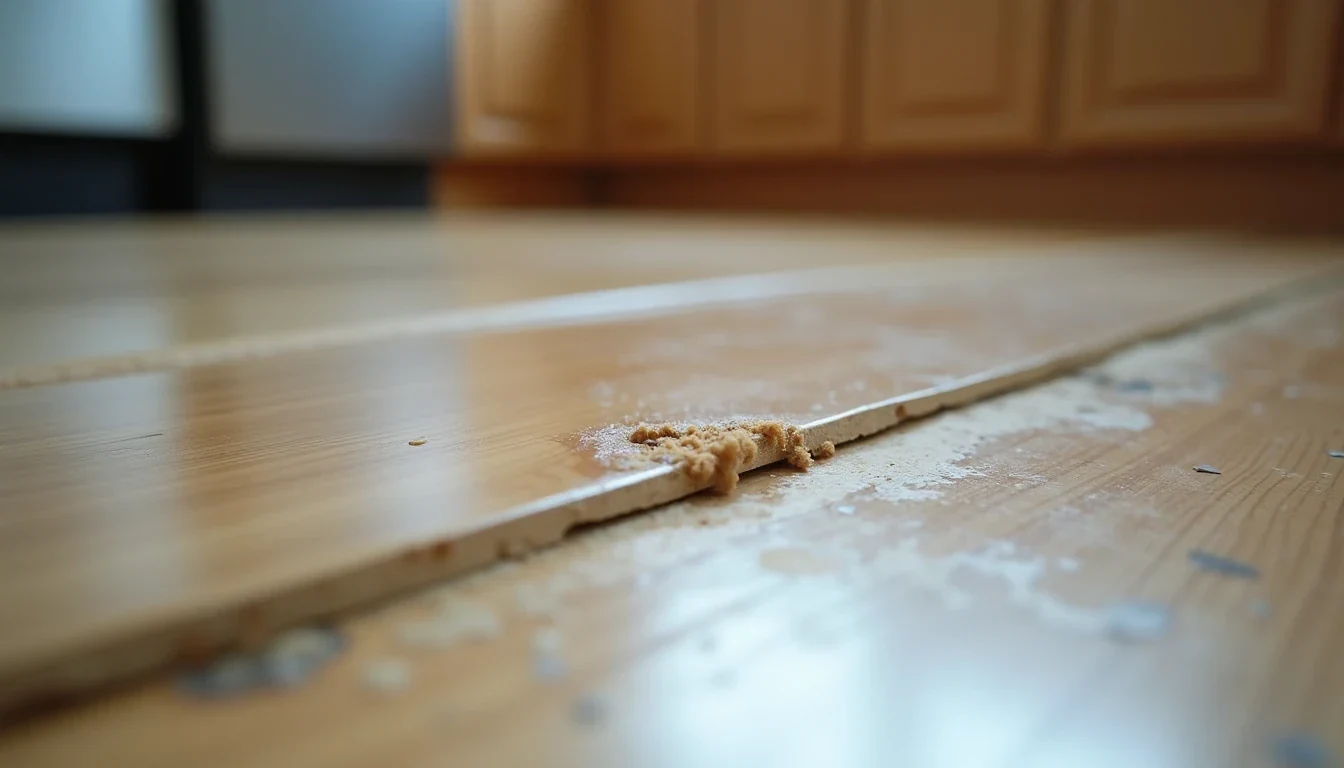
A leaking dishwasher does not announce itself with a dramatic flood. It gives you a slow edge soak under the cabinet line. Then the skirting starts to sit funny, then the board tips up at the joint. That is laminate’s favourite disaster.
On laminate, the weak point is the HDF core. Water reaches the edge, the board takes on moisture, and the swelling is usually permanent. The surface print may still look fine while the plank underneath has already started to mushroom. Once that happens, replacement is the real fix.
Engineered wood handles the same event better than laminate, but not cleanly. If water sits long enough, the veneer can cup or crown, and the ply beneath can separate. It is still wood, so it still reacts. A good wear layer can sometimes be salvaged by sanding later if the damage has not gone too deep.
Vinyl is the one that can survive a spill without sulking. A rigid SPC or a decent glue-down LVT is built for topical water, and some ranges are openly sold as 100% waterproof on the surface. This does not mean the whole room is flood-proof. Water can still work its way under poor joins, along an unsealed perimeter, or through a badly prepared subfloor. The plank may survive while the installation fails around it.
Price tells you more than the brochure
At the time of writing, the South African market already shows how wide the gap is between the three products.
Tile Africa’s laminate range includes AC4 products such as Legno Nat Oak at R239.99 per m2, and AC5 options such as Cottage Duero Oak at R349.99 per m2. FINfloor lists AGT Bella NEO Yuka at R312 per m2, AGT Natura Line Trend at R345 per m2, and Black Forest Plus Oakwood Villa at R675 per m2. Those are all laminates, but they are not the same floor dressed in different advertising. The cheaper boards are fine for dry living spaces. The higher-end AC5 material is built with better density and better spill tolerance, and the price shows it.
For vinyl, FINfloor lists Aurora II Dione glue-down vinyl at R272 per m2, Galaxy II Malin at R341 per m2, Sapphire Wide Jasper SPC at R485 per m2, Sapphire Wide at R526 per m2, and Diamond Core SPC+ starting at R575 per m2, with some colourways at R641 per m2. Stiles lists Aspen Living Aspen Oak luxury vinyl at R339 per m2. The numbers tell a story. Glue-down LVT sits lower. Rigid SPC with an attached underlay and a stronger wear layer climbs fast.
Engineered wood is the expensive cousin. Stiles lists Grand Oak Engineered Hardwood Flooring at R1,889 per m2. That is not a typo. Real timber on a stable base costs real money, and the refinishable face is part of what you are paying for.
Where each floor works best
Laminate works in dry bedrooms, upstairs living rooms, and budget-conscious family spaces where the look matters more than the floor ever getting wet. If you want oak appearance without oak money, it still has a place. Just keep it away from leaky appliances, external doors that let in driving rain, and bathrooms where the extractor fan is decorative rather than functional.
Engineered wood belongs where the owner wants the warmth of real timber and accepts the maintenance that comes with it. It suits formal living rooms, bedrooms, and well-controlled interiors. In a Highveld house with dry winter air and air conditioning, it behaves better than in a damp coastal unit with poor ventilation.
Vinyl is the practical choice for kitchens, sculleries, laundries, rentals, and family homes with hard use. In KZN humidity or Cape winter damp, it is usually the least fussy of the three. It also gives you the quietest underfoot feel if you buy the right product. A rigid SPC with attached IXPE underlay can cut impact noise by around 11 dB on some ranges, while laminate tends to sound hollow unless the underlay is specified properly.
Where each one fails
Laminate fails loudly and permanently. Once the fibreboard swells, the plank does not recover. You can replace it, but patching a board in the middle of a room is awkward and often means lifting more of the floor than the owner expected. Refinishing is off the table.
Engineered wood fails more gracefully, but it still fails. Water can distort the boards, cheap veneer can be too thin to sand, and a bad scratch can expose the layer beneath. You get a longer service life than laminate if the board is well made, but not the carefree behaviour people imagine when they hear the word “wood”.
Vinyl usually fails at the edges and the joints. Glue-down products can release if the subfloor was not prepared properly or if moisture gets underneath. Click-lock SPC can separate if the locking profile is abused or if the substrate is badly uneven. Softer WPC-style floors dent more easily under heavy furniture than rigid SPC.
The warranty wording is doing a lot of sneaky work
“Water-resistant” is not the same promise as “waterproof surface”. The first usually means the floor can handle spills for a limited time before the core starts to suffer. FINfloor’s AGT Bella NEO Yuka, for example, is marketed with 24-hour topical water resistance. That still leaves the core vulnerable once water gets past the edges or sits too long.
“Waterproof surface” usually refers to the top layer, not the whole installation. FINfloor’s Diamond Core SPC+ says 100% waterproof protection against topical and pure, uncontaminated water. That is a strong claim, but it does not cover a flood from the slab, a failed appliance hose, or a bad installation detail.
“Suitable for wet areas” is the strongest wording, and it is mostly the language of SPC vinyl. Even then, the warranty usually assumes the perimeter is sealed, the subfloor is correct, and standing water is not ignored for days. It is a product claim, not a licence to be careless.
What to specify on the order
If you are buying laminate, ask for the AC rating, board thickness, core density, water-resistance duration, and the matching underlay. For kitchens, do not accept vague promises. Ask how the edges are sealed and what the warranty excludes.
If you are buying engineered wood, ask for veneer thickness, total thickness, core construction, and whether the floor can be refinished. A 2 mm decorative face is very different from a 4 mm or 6 mm wear layer when the floor starts showing life.
If you are buying vinyl, ask whether it is glue-down or click-lock, whether the core is SPC or a softer composite, what the wear layer is, and whether the product includes attached underlay. Also ask for the subfloor flatness tolerance. If the installer shrugs, expect telegraphing later.
What to put on the spec sheet
- Laminate for dry rooms only unless the warranty clearly covers short-term topical moisture
- AC4 or AC5 if the floor will see hard family use
- Engineered wood only if the owner accepts maintenance and wants a refinishable timber face
- SPC or quality glue-down vinyl for kitchens, laundries, and wet-prone rooms
- Subfloor moisture testing before installation
- Proper expansion gaps for floating floors
- Underlay specified by the product, not guessed on site
- Warranty wording checked for standing water, flooding, and installation exclusions
A board that looks like oak is not yet an oak floor. Open it up, and the truth sits in the core.